

Kickboxing Career Progression Stages: Fighter's Roadmap
 Lukas
LukasKickboxing career progression stages define the structured path every fighter travels from their first guard drill to competing under the lights of GLORY or ONE Championship. The journey breaks into three distinct phases: Early, Intermediate, and Competitive. Each phase carries its own skill benchmarks, competition entry points, and ranking dynamics. Organizations like WKA, KOK, WAKO, and WKU regulate the amateur side; GLORY, ONE Championship, and RISE govern the elite end. Understanding where you sit on that spectrum, and what it takes to move forward, is the difference between a fighter who stalls and one who builds a real career.
1. The kickboxing career progression stages at a glance
Kickboxing career progression is not a single ladder. It is a branching system where training frequency, athletic background, and competition choices all shape how fast you move. The three core stages are Early (roughly the first 6 to 12 months), Intermediate (1 to 2 years of consistent training), and Competitive (3 to 5 or more years with dedicated fight preparation and 15 or more bouts). Each stage demands a different mental model, not just a different training plan.
Ranking systems mirror this progression precisely. The KickboxHub ranking methodology assigns a Rookie K-factor of 60 to fighters in their first 15 bouts, creating high volatility that reflects genuine uncertainty about a newcomer's true level. Once a fighter crosses that 15-bout threshold, the system shifts to an Elite K-factor of 20, stabilizing rankings to reflect a more accurate competitive picture. That numerical shift is not administrative. It marks a real transition in a fighter's career identity.

2. Early stage: foundational training and novice competition readiness
The Early stage is defined by one priority: building a technical foundation that will not collapse under pressure. Guard position, basic punch and kick combinations, footwork patterns, and defensive reflexes form the curriculum. Fundamental skills take roughly 3 to 6 months of consistent training at 2 to 3 sessions per week to solidify. That timeline assumes no prior combat sports background.
Competition eligibility at this stage is tightly regulated. Under WAKO and WKU rules, Full Contact and K-1 disciplines require a minimum age of 16, while Point Fighting and Light Contact open at age 10. This is not arbitrary gatekeeping. It reflects the physical and psychological demands of ring contact. Most Early-stage fighters spend their first 8 to 24 classes in controlled pad work and light technical sparring before any competitive exposure.
Grading systems at this level serve a motivational and diagnostic function. Quarterly grading tests assess attendance, technical skills, fitness, and behavior, with belt advancement requiring demonstrated competency across all four criteria. The belt color itself matters less than what the test reveals about a fighter's readiness to absorb more complex instruction.
Key markers of Early-stage readiness for novice competition:
- Consistent guard position under light pressure
- Clean execution of jab, cross, roundhouse kick, and front kick combinations
- Basic footwork: lateral movement, pivoting, and range management
- Ability to absorb and reset after contact without freezing
- Completion of at least 8 to 12 weeks of structured preparation before entering any official bout
Pro Tip: Safe progression into competition depends on instilling defensive responsibility before the first bout. Eight to twelve weeks of structured preparation is the recognized minimum before entering a competitive ring, regardless of how athletic you are.
3. Intermediate stage: skill refinement, sparring development, and amateur competition
The Intermediate stage is where most fighters either accelerate or stall. The raw excitement of early gains fades, and the real work of technical refinement begins. This phase typically spans 1 to 2 years of consistent training, with the defining shift being the transition from learning techniques to owning them under live pressure.
The plateau hits hard here. Around 4 to 6 months, visible progress slows as the body internalizes movement patterns that were previously conscious decisions. This is not regression. It is consolidation. The fighters who push through it do so with quality coaching and deliberate sparring, not just more pad rounds.
Four milestones define Intermediate-stage progress:
- Combination fluency. Linking punches, kicks, and knees into coherent offensive sequences without telegraphing intent.
- Defensive integration. Slipping, rolling, checking kicks, and using the guard as an active tool rather than a passive shield.
- Sparring composure. Managing distance and emotional control under genuine pressure. Effective sparring develops over 12 to 24 months and is non-negotiable for competition readiness.
- Amateur circuit entry. WKA and KOK amateur events provide the first real competitive data points. These bouts expose technical gaps that no amount of pad work will reveal.
"Fighters who prioritize technical efficiency and fundamental movement early avoid the development plateaus that trap stronger but less disciplined beginners." The data supports this: athletes from wrestling or boxing backgrounds often reach amateur readiness in 1 to 2 years, cutting the typical 3 to 4 year timeline nearly in half.
Ranking volatility at this stage is still elevated. Fighters with fewer than 15 bouts remain under the Rookie K-factor of 60, meaning a single upset win or loss can shift their ranking position significantly. That volatility is a feature, not a flaw. It reflects the genuine unpredictability of fighters still finding their competitive identity.
4. Competitive stage: professional readiness, elite leagues, and ranking stabilization
The Competitive stage is a different sport. The margin for technical error collapses, conditioning becomes a tactical weapon, and the organizational stakes shift from local amateur circuits to global professional promotions. Reaching this stage typically requires 3 to 5 or more years of dedicated training, 15 or more official bouts, and a fight record that demonstrates consistent performance against credible opposition.
Professional promotions like GLORY and ONE Championship do not use belt ranks. Progression here is measured by fight record, opponent caliber, and conditioning. A fighter's strength of schedule matters as much as their win percentage. Beating four unranked opponents tells a matchmaker far less than splitting bouts with two ranked contenders.
| Criteria | Amateur Stage | Competitive/Pro Stage |
|---|---|---|
| Ranking system | Belt and grading based | Fight record and K-factor ranking |
| Governing bodies | WKA, KOK, WAKO, WKU | GLORY, ONE Championship, RISE |
| K-factor volatility | Rookie K-factor: 60 | Elite K-factor: 20 |
| Bout frequency | Occasional, structured | Regular, high-stakes |
| Opponent selection | Age and weight matched | Ranked and performance based |
Fighters like Ryujin Nasukawa, whose 17-3 record reflects years of competitive exposure, illustrate what ranking stabilization looks like in practice. The Elite K-factor of 20 means their ranking moves in measured increments, rewarding consistency rather than reacting to single-bout variance.
Pro Tip: At the Competitive stage, your opponent selection is your career strategy. Chasing easy wins inflates your record but stalls your ranking. Seek out ranked opposition early, absorb the losses if they come, and let the data tell the real story.
5. How kickboxing ranking systems reflect career progression
Ranking systems are the most honest mirror a fighter has. The KickboxHub ranking methodology uses a K-factor model borrowed from chess rating systems and adapted for combat sports volatility. The logic is precise: a fighter with 3 bouts should not have a ranking as stable as a fighter with 30. The Rookie K-factor of 60 acknowledges that uncertainty explicitly.
Here is how the system tracks progression in practice:
- Bouts 1 to 14: High-volatility Rookie K-factor of 60. Rankings shift significantly after each result, reflecting genuine uncertainty about the fighter's true competitive level.
- Bout 15 and beyond: Elite K-factor of 20 activates. Rankings stabilize, rewarding consistency and penalizing volatility less harshly.
- Strength of schedule: Opponent ranking at the time of the bout factors into point calculations. Beating a higher-ranked fighter yields more movement than beating an unranked one.
- Database integration: Every bout result feeds into the kickboxing rankings leaderboard, creating a transparent, data-driven career record.
The Kickboxhub fighter database tracks these transitions in real time. Reviewing the Mory Kromah kickboxing record alongside the Yuki Yoza fighter profile illustrates how two fighters at different career stages carry different K-factor designations, and how their ranking trajectories diverge accordingly. This is not abstract math. It is the clearest available signal of where a fighter stands in the competitive hierarchy.
Consistent attendance and conduct standards at the gym level feed directly into this progression. Fighters who train irregularly accumulate bouts slowly, staying under the Rookie K-factor longer and delaying the ranking stability that comes with Elite status.
6. Comparing key kickboxing organizations across career stages
Not all organizations serve the same stage of a fighter's development. Choosing the wrong competitive environment at the wrong time is one of the most common and costly mistakes in a fighter's career.
| Organization | Stage | Ruleset focus | Age minimum | Pathway function |
|---|---|---|---|---|
| WAKO | Early to Intermediate | Point Fighting, Light Contact, Full Contact | 10 to 16 depending on discipline | Entry-level amateur competition |
| WKU | Early to Intermediate | Full Contact, K-1 | 16 for ring disciplines | Structured amateur progression |
| WKA | Intermediate | Full Contact, K-1 | 16+ | Amateur to semi-pro bridge |
| KOK | Intermediate to Competitive | K-1 style | 18+ | Competitive amateur and emerging pro |
| GLORY | Competitive | K-1, full rules | Professional | Elite global ranking circuit |
| ONE Championship | Competitive | K-1, full rules | Professional | Premier Asian and global platform |
| RISE | Competitive | K-1 style | Professional | European elite circuit |
The weight class rankings across these organizations reflect different competitive densities. GLORY's heavyweight division carries a different ranking weight than a regional WKA bracket. Fighters who understand this structure make smarter decisions about when to turn professional and which promotion aligns with their current level.
Following tournament brackets at the Competitive stage is not just entertainment. It is competitive intelligence. Knowing who is active, who is ranked, and which promotions are running tournaments in your weight class shapes every training camp decision.
Key takeaways
Kickboxing career progression requires matching your training phase, competition choices, and ranking strategy to your actual experience level, not your ambition.
| Point | Details |
|---|---|
| Three defined stages | Early, Intermediate, and Competitive stages each carry distinct skill benchmarks and competition entry points. |
| Ranking volatility is intentional | The Rookie K-factor of 60 protects new fighters from ranking distortion until 15 bouts are logged. |
| Belt ranks end at the pro level | GLORY and ONE Championship measure progression by fight record and opponent caliber, not color rank. |
| Plateaus signal growth | The 4 to 6 month plateau marks internalization, not stagnation. Quality coaching and sparring break it. |
| Organization choice shapes trajectory | Moving from WKA and KOK to GLORY or RISE requires deliberate timing and a credible fight record. |
Why most fighters misread their own progression stage
The most common mistake I see fighters make is conflating training time with competitive readiness. A fighter who has trained for two years but avoided sparring is not an Intermediate-stage competitor. They are an Early-stage fighter with a longer resume. The stage is defined by what you can do under pressure, not how long you have been in the gym.
The Rookie K-factor data makes this concrete. Fighters who rush into bouts before their technical foundation is solid accumulate losses that shift their ranking downward under high volatility conditions. Those early losses are not just defeats. They are ranking anchors that take significantly more wins to correct once the Elite K-factor kicks in. I have watched fighters with genuine talent spend two extra years climbing back from a poor early record that a more patient approach would have avoided entirely.
The plateau around 4 to 6 months is the real test of a fighter's commitment. Every serious competitor I have analyzed hit it. The ones who treated it as a signal to find better coaching and more deliberate sparring partners broke through it. The ones who trained harder without training smarter did not. Recovery, quality of opposition in sparring, and nervous system preparation matter as much as volume at this stage.
Use the data available to you. The kickboxing rankings leaderboard is not just a scoreboard. It is a career planning tool. If you know where you sit in the K-factor system and who is ranked above you in your weight class, you can build a fight schedule that accelerates your progression rather than stalling it.
— Lukas
Track your progression with KickboxHub
KickboxHub is the most comprehensive kickboxing database available, covering fighters, events, results, and rankings across every major organization from WKA to GLORY.
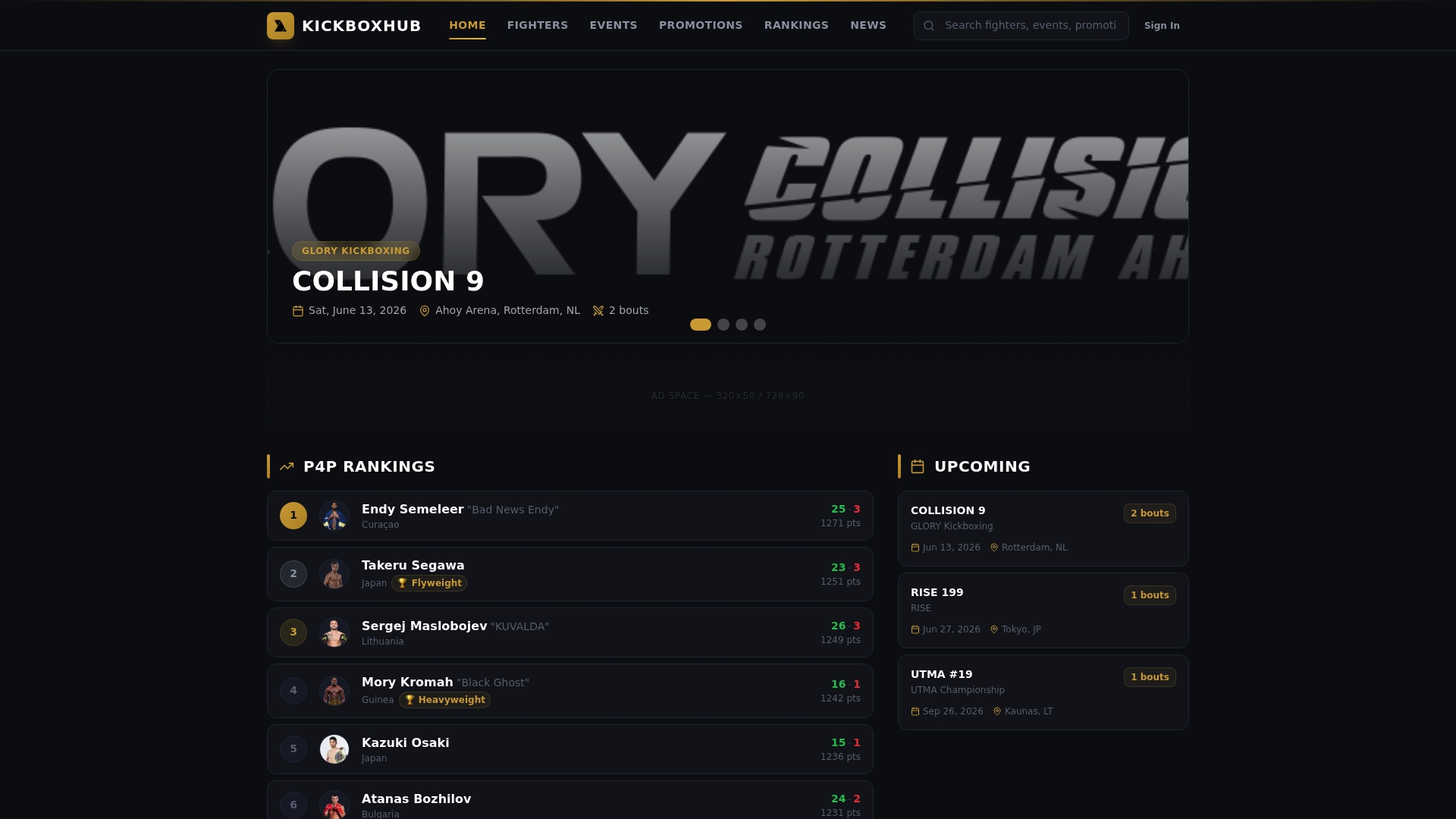
Whether you are mapping your first amateur bouts or targeting a ranked opponent in a professional circuit, KickboxHub gives you the data to make informed decisions. Browse the fighters database to study records and career trajectories at every stage. Explore active kickboxing promotions to identify the right competitive environment for your current level. Find the right training environment through the gyms and teams directory. The path from novice to elite is clearer when the data is in front of you.
FAQ
How long does each kickboxing career stage take?
The Early stage spans roughly 3 to 12 months, the Intermediate stage takes 1 to 2 years, and the Competitive stage begins after 3 to 5 years of dedicated training with 15 or more bouts logged. Athletes with prior combat sports backgrounds can compress the Early and Intermediate timelines significantly.
What is the Rookie K-factor in kickboxing rankings?
The Rookie K-factor of 60 is a high-volatility ranking parameter applied to fighters in their first 15 official bouts, protecting their ranking from large swings while competitive data accumulates. After 15 bouts, the system shifts to an Elite K-factor of 20, stabilizing rankings to reflect a fighter's true competitive level.
Do professional kickboxers use belt ranks?
No. Professional promotions like GLORY and ONE Championship do not use belt ranking systems. At the professional level, progression is measured by fight record, opponent caliber, and performance in ranked competition circuits.
When can you enter amateur kickboxing competition?
Under WAKO and WKU regulations, Full Contact and K-1 disciplines require a minimum age of 16, while Point Fighting and Light Contact open at age 10. Most federations also require a minimum preparation period of 8 to 12 weeks before a fighter's first competitive bout.
How do you move from amateur to professional kickboxing?
The transition from amateur circuits like WKA and KOK to professional promotions like GLORY or RISE depends on fight record, opponent quality, and physical conditioning. There is no universal belt or certification. A credible amateur record against ranked opposition is the primary signal that professional matchmakers look for.
Recommended

Comments (0)
Sign in to leave a comment.
No comments yet. Be the first!